Merck, Novo Nordisk, and Sanofi Lead Pharma's AI Revolution Amid Workforce Cuts and Strategic Acquisitions
April 27, 2026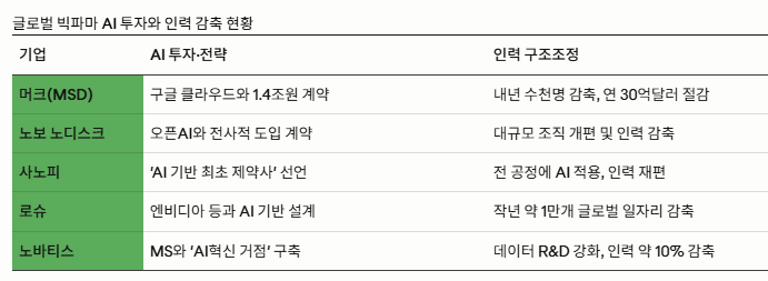

Merck’s biotech acquisitions—Verona, Sidara, and Turn—are aimed at bolstering its pipeline and integrating AI to improve development success rates.
Novo Nordisk has signed a contract with OpenAI to deploy enterprise-wide AI, targeting substantial cost cuts of about 8 billion Danish kroner annually through organizational optimization by year-end.
Across the industry, savings from workforce reductions are flowing into rapid M&A and AI investments to secure new drug pipelines and expand technology-enabled capabilities.
Cash saved from manpower reductions is being reinvested into aggressive M&A and AI infrastructure to secure new drug pipelines and scale capabilities, with Merck acquiring startups Verona, Sidara, and Turn to feed its A-Tik AI system.
Sanofi’s AI-driven transformation parallels large-scale workforce reductions at Roche and at Microsoft-leaning Novartis, underscoring a industry-wide pivot to AI across R&D and operations.
Merck is partnering with Google Cloud to deploy Gemini AGENTIC AI across R&D, manufacturing, sales, and operations, with up to $1 billion investment to enable an AI agent-enabled autonomous corporation.
The Novo Nordisk OpenAI deal accompanies a broad reorganization aimed at reducing manpower and achieving cost efficiency of roughly 8 billion kroner per year.
Sanofi is pursuing a company-wide AI transformation to operate as an AI-driven pharma business, including R&D prioritization shifts; major peers Roche and Novartis are also cutting thousands of jobs as part of their AI strategies.
The Google Cloud partnership aims to enable hypothesis generation, experiment design, and data-driven business decisions through Gemini AGENTIC, signaling a bold move into autonomous AI-enabled operations.
Korea faces barriers to AI-enabled drug development, with strong AI infrastructure but a shortage of professionals capable of integrating AI into development, prompting calls for government incentives and regulatory support.
Korean industry experts emphasize that AI adoption hinges on organizational efficiency and reinvestment in drug development, not just technology spending, and advocate policy support and retraining for pharma workers.
Merck plans significant workforce reductions to save about $3 billion annually by end-2027, funding AI initiatives and new drug development activities in what’s described as an 'AI Big Bang'.
Summary based on 2 sources