Low-Carbon Aluminium Recycling: Global Innovations Transform Industry by 2035
April 4, 2026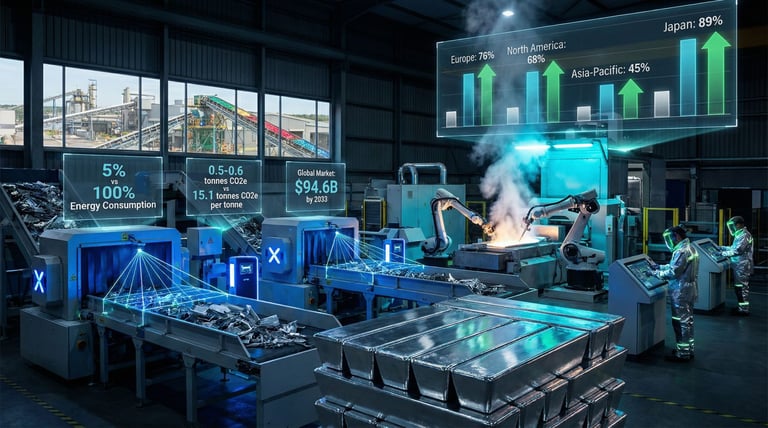

Low-carbon aluminium recycling uses existing feedstock, advanced sorting, and efficient processing to achieve far lower energy use and emissions than primary production.
Across Europe, North America, Asia-Pacific, and Japan, infrastructure, regulation, and maturity vary, but collaboration and technology transfer link regions and accelerate development.
By 2035, substantial capital will be needed for conventional melting, advanced sorting, purification, and integrated facilities to scale capacity.
Scrap sources from automotive, consumer electronics, construction and other waste streams face contamination, requiring strategic sourcing and processing innovations to expand usable scrap.
Future capacity hinges on technology evolution such as plasma purification, hydrometallurgy, molecular-level sorting, and digital tools (IoT, AI, blockchain) to reduce costs and grow processing capability.
Certification and verification programs will rely on third-party audits and standardized measurements, with regional emphasis varying from lifecycle assessments to facility-level monitoring.
Regulatory frameworks and carbon pricing, along with corporate sustainability programs, create premium value for low-carbon recycled aluminium and influence regional market development.
Different processing technologies entail different capital and operating costs; ROI depends on volumes, quality improvements, and market conditions.
Wrought alloys demand tighter chemical control and pose metallurgical challenges compared with cast alloys, shaping processing strategies.
Advanced separation uses X-ray fluorescence, eddy current and electromagnetic methods, plus machine-learning-enhanced optical sorting to manage alloy composition and contaminants.
Demand drivers include automotive lightweighting, construction, and beverage can packaging, all benefiting from certified low-carbon aluminium.
Recycling uses about 95% less energy than primary production, with lifecycle analyses (Scope 1-3) capturing emissions and regional variations.
Summary based on 1 source
Get a daily email with more Science stories
Source
Discovery Alert • Apr 3, 2026
Low-Carbon Aluminium Recycling: Energy & Benefits